
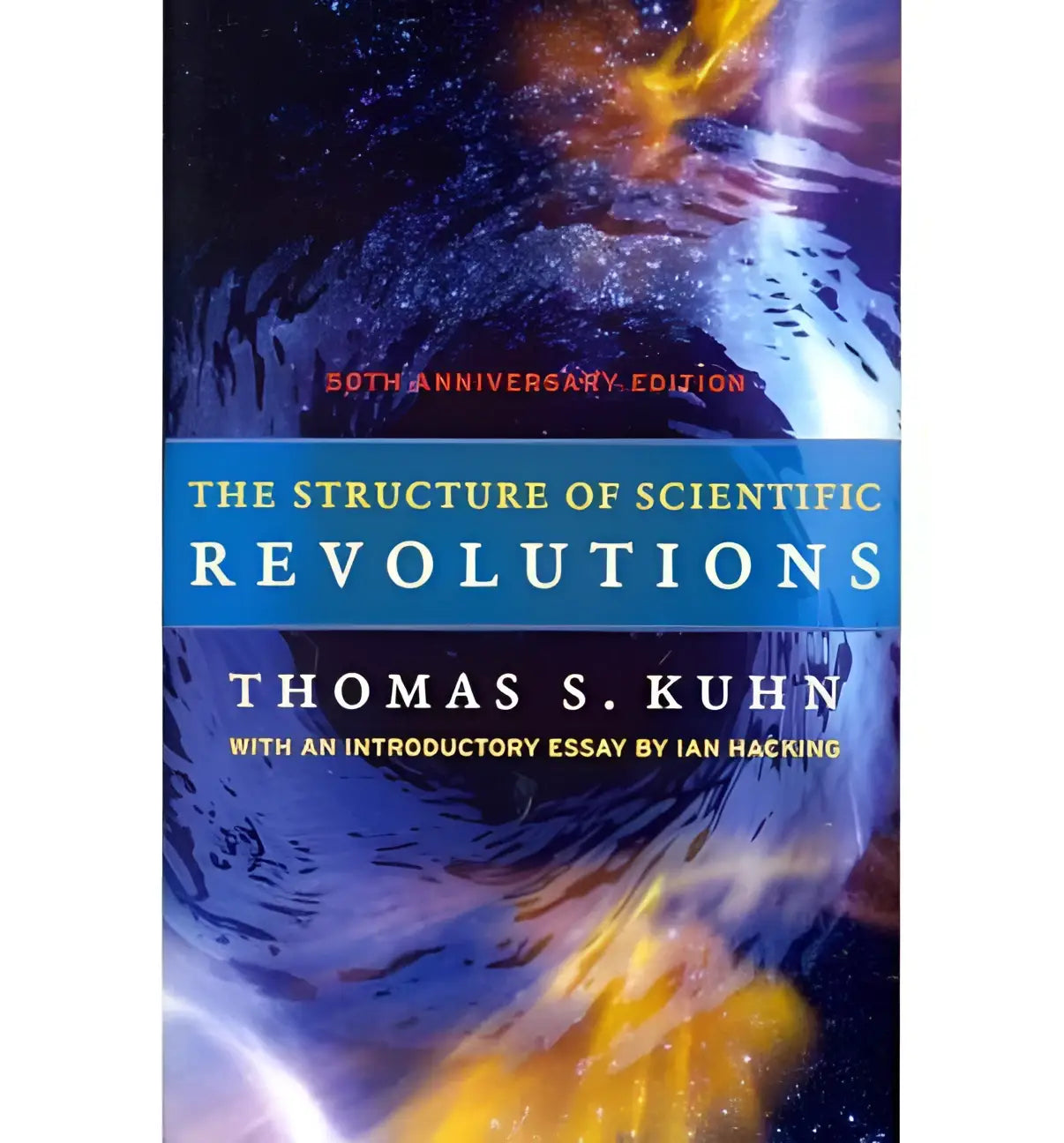

50th Anniversary Edition of The Structure of Scientific Revolutions
This influential work by Thomas S. Kuhn breaks through long-standing linear notions of scientific progress. Kuhn discusses how real scientific revolutions take place outside everyday incremental experiments and data analysis, and how groundbreaking ideas change established ways of thinking.
Description
In The Structure of Scientific Revolutions, Kuhn explains that scientific progress does not proceed gradually and linearly, but is characterized by sudden shifts in paradigms. This book, first published in 1962 and now as a 50th anniversary edition, is a classic in the philosophy and history of science. Kuhn shows how revolutionary insights make science dynamic and changeable, and these insights remain relevant in modern times, even beyond physics.
This edition includes a new introduction by Ian Hacking, which clarifies and connects Kuhn’s core concepts such as paradigm and incommensurability with contemporary scientific developments. With a refreshed design and an expanded index, this book is indispensable for readers who want to delve into the structure of scientific revolutions.
Product specifications
- Author: Thomas S. Kuhn
- Publisher: The University of Chicago Press
- Imprint: University of Chicago Press
- Release date: 2012-04-30
- Number of pages: 264
- ISBN: 9780226458120
- Subject: Philosophy of science
- BISAC: SCIENCE / Philosophy & Social Aspects
About the author
Thomas S. Kuhn (1922–96) was a professor of linguistics and philosophy at the Massachusetts Institute of Technology. His other works include The Essential Tension, Black-Body Theory and the Quantum Discontinuity, 1894–1912, and The Copernican Revolution.