
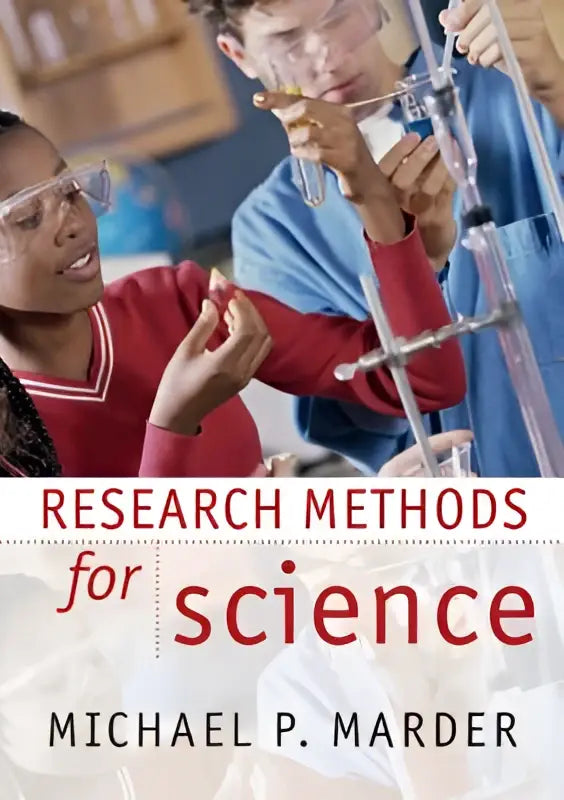

This textbook by Michael P. Marder offers a unique introduction to the design, analysis, and presentation of scientific projects. It is an essential handbook for students in science and mathematics, in which the most important research methods are clearly explained. Topics such as experimental design, statistics, mathematical modeling, and writing scientific papers are covered in depth.
Contents and features
The book covers fundamental techniques such as hypothesis testing, functional relationship measurements, and observational research. In addition, crucial aspects of experimental research are discussed, including error control, calibration, data analysis, and laboratory safety. Statistical concepts such as standard errors, p-values, and elementary tests are explained in a practical way. Mathematical models, from order-of-magnitude analyses to Fourier transforms and differential equations, are introduced. It also provides guidelines for consulting scientific literature and preparing presentations. An extensive instructor’s guide is available.
Specifications
- Author: Michael P. Marder (University of Texas, Austin)
- Publisher: Cambridge University Press
- Format: Trade paperback (US)
- Publication date: 2011-01-27
- Number of pages: 234
- ISBN: 9780521145848
- Theme: Scientific equipment, experiments and techniques
- BISAC: SCIENCE / Physics / General
About the author
Michael Marder is a professor of physics at the University of Texas, Austin. He founded the UTeach program to train teachers in science and mathematics. His teaching experience in scientific research forms the basis of this unique textbook. Marder is also the author of the graduate book Condensed Matter Physics.