

Introduction to Condensed Matter Physics
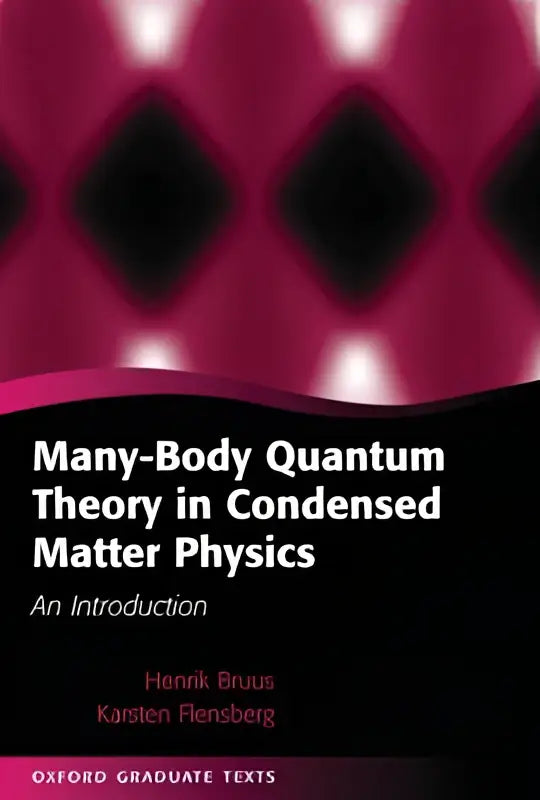
This textbook by Henrik Bruus introduces techniques from quantum field theory applied to condensed matter systems. It covers fundamental concepts and modern applications in electron systems, mesoscopic systems, and nano-structures. It is intended for advanced undergraduate and master’s students with an interest in theoretical and applied matter physics.
Overview
The text provides a thorough and coherent treatment of many-body quantum theory while maintaining mathematical precision. Topics discussed include, among others, second quantization, many-body Green's functions, Feynman diagrams at finite temperature, and bosonization. In addition, the book covers traditional transport theory and advanced correlation phenomena in condensed matter systems.
Practical applications include transport in bulk and mesoscopic systems with attention to the Landauer-Büttiker formalism and electronic behavior in one-dimensional systems via Luttinger liquid and bosonization techniques. With pedagogical exercises, it is suitable both as a reference work and as support for courses.
Specifications
- Author: Henrik Bruus (MIC - Department of Micro and Nanotechnology, Technical University of Denmark)
- Publisher: Oxford University Press
- Publication date: 2004-09-02
- Number of pages: 464
- ISBN: 9780198566335
- Subject: Condensed matter physics (liquid state and solid state physics)
- Series: Oxford Graduate Texts
Author
Henrik Bruus, MIC - Department of Micro- and Nanotechnology, Technical University of Denmark
Karsten Flensberg, Oersted Laboratory, Niels Bohr Institute, Denmark