
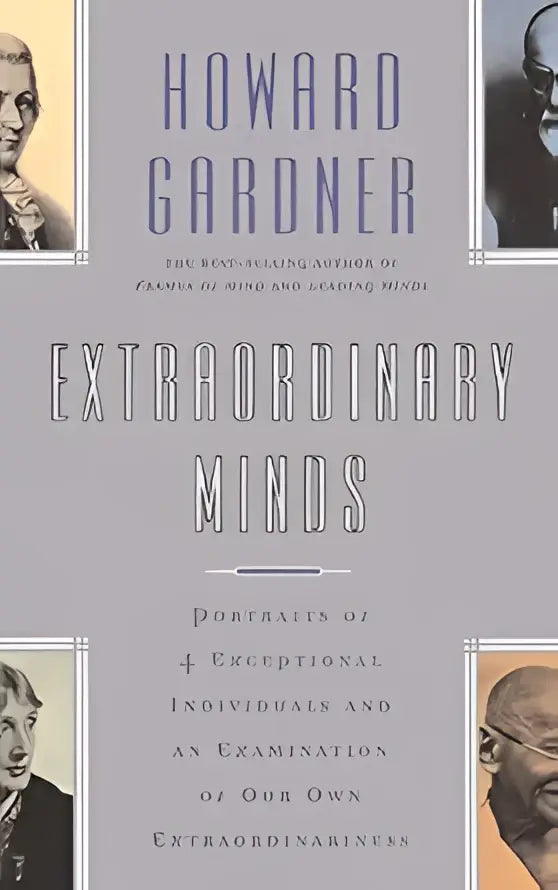

About the book Extraordinary Minds
Fifteen years ago, psychologist and educator Howard Gardner introduced the concept of multiple intelligences. He gained widespread recognition by challenging the traditional view that intelligence consists solely of verbal and analytical skills. Gardner advocates for a broader understanding of intelligence in which creativity, spatial insight, and the ability for self-reflection and social understanding also play a role.
Content and themes
In Extraordinary Minds, Gardner explores the question of whether there are traits that all exceptional people, regardless of their field or era, have in common. He conducts an analysis based on four examples from history:
- Mozart: master of his discipline
- Freud: innovative founder of a new discipline
- Woolf: great introspective thinker
- Gandhi: influential leader
These individuals demonstrate that success does not arise from brute force, but from the ability to recognize one's own qualities, analyze events, and learn from setbacks.
Questions addressed in the book
- How do extraordinary eras arise, such as Athens in the fifth century BC or New York in the mid-twentieth century?
- What is the relationship between genius, creativity, fame, success, and moral exceptionalism?
- Does being exceptional lead to a happier life, or does it primarily bring additional responsibilities?
Target audience and use
Extraordinary Minds is written in English and suitable for self-study, education, and professional development. The book is aimed at readers with an advanced language level (C1–C2) who are interested in psychology, leadership, and creativity.
Reliable delivery via Intertaal
Intertaal is your reliable supplier of quality learning materials and guarantees fast delivery so you can immediately benefit from this valuable resource.